
New self hosted Cloudmox is live!
We are thrilled to announce that the self hosted version Cloudmox is officially live!
When we published our preview post taking stock of our upcoming rollout, we set out with a clear mission: to bridge the gap between technical infrastructure engineers and end-users by turning Proxmox virtualization into a clean, multi-tenant cloud platform.
Today, that vision is fully operational. Hosting providers, IT teams, and MSPs across Europe are already using Cloudmox to streamline their virtualization workflows, empower non-technical users, and secure their Proxmox environments.
What Cloudmox delivers out of the box
If you visited our site during pre-launch, you saw our core commitments. We’re excited to share that every feature featured on cloudmox.eu is now fully available and active:
One-line, zero-agent setup: Cloudmox connects directly to your Proxmox clusters via the Proxmox API. You don't need to install agents on your hypervisors—paste a single setup command on your Cloudmox management host, connect your cluster API credentials, and you're ready to go.
A cleaner, distraction-free UI: Proxmox is built for infrastructure engineers. Cloudmox gives non-technical users, support staff, and customers a streamlined interface containing only the options they need. No more misconfigured network bridges or accidentally modified hypervisor settings.
Turnkey whitelabel VPS portal: Effortlessly offer VPS hosting to third parties. Custom colors, corporate logos, and custom SMTP settings let you present a completely branded portal—and your reseller tenants can even brand the panel for their end customers.
Centralized security & access control: Eliminate node-by-node user creation. Enforce mandatory 2FA, granular permission sets, and maintain comprehensive audit logs to track who did what and when.
Real-time graphs & insights: Visualize load, compare trends over time, and catch performance bottlenecks early with real-time cluster and VM metrics.
Under the hood: The Default Resource Profile (DRP) approach
One of the most powerful innovations in Cloudmox addresses a long-standing challenge in managing Proxmox at scale: cluster sprawl and resource governance.
The 30-node barrier per cluster has been surpassed
Proxmox recommends keeping clusters to a manageable size (typically under 30 nodes). As a hosting provider or enterprise grows, you naturally end up with multiple clusters, maybe spread across regions, varied hardware generations, or distinct storage types. Manually deciding where every tenant places their virtual machines quickly becomes an operational nightmare.
The Cloudmox solution: Unified resource pools
Cloudmox treats all your Proxmox clusters as a single, unified infrastructure pool, governed effortlessly through Resource Profiles.
At the apex of this architecture is the Default Resource Profile (DRP)—the "mother" configuration of your Cloudmox instance.
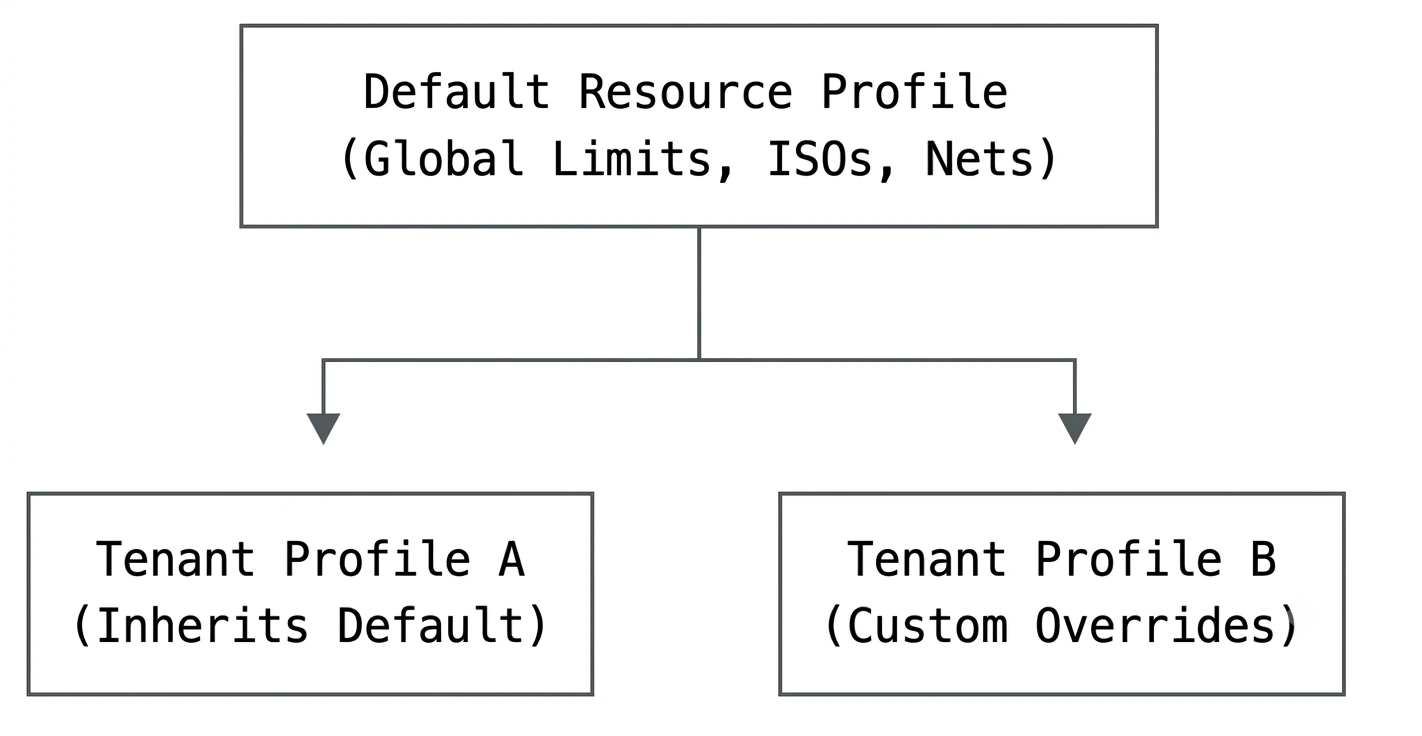
When a VM is created, a node is selected to create the VM on, and the Resource Profile of that node is used to create the VM on. Thus if one clusters uses VMBR1 for internet access, and another uses VMBR12, the VM is created with the correct settings. Same for storages and other settings
Key capabilities of the Default Resource Profile:
Global & cluster-level safeguards:
Define baseline limits for CPU, RAM, storage allocation, and maximum total VPS count. You can set limits globally or enforce per-cluster caps to ensure no single hypervisor cluster gets overcommitted.
User-friendly resource mapping:
Instead of exposing raw storage IDs or complex network tags, the DRP lets you assign friendly names to storages, cap IOPS, toggle SSD/Discard flags, and define allowable network bridges.
Standardized ISO & OS deployment:
Map ISO images across all nodes with friendly names and pre-selected OS options. The system replicates these settings automatically, guaranteeing that users spin up VMs with working, supported OS configurations every time.
Seamless multi-tenant inheritance:
When a new customer or internal department is onboarded, they automatically inherit the rules defined in the Default Resource Profile. If a specific customer requires dedicated nodes, custom storage pools, or higher limits, you simply apply a Tenant Resource Profile (TRP) to override the defaults for that tenant alone.
This enables safe Tenant self registration but limits ways of abuse.
Get started today
Whether you want to sell white-labeled VPSs, offer self-service infrastructure to internal developer teams, or simplify daily support operations, Cloudmox makes Proxmox accessible, secure, and effortless.
Book a live demo or request trial access at cloudmox.eu.
Check out our Help & Installation documentation to see how simple setting up your Default Resource Profile can be.
Thank you to all our early partners and customers who helped us reach this milestone. We're just getting started!